

A hiatal hernia can be indicated by difficulty swallowing or heartburn. How this is treated is best decided by a gastrointestinal specialist and an experienced surgeon working as a team.
Hiatal hernia
 Dr.Med.Enrico Pöschmann
  8-Dec. 2022
 Symptoms of a hiatal hernia
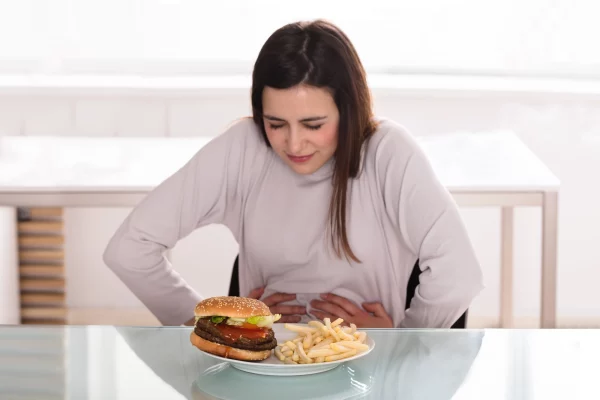
Do you suffer from acid regurgitation, shortness of breath after eating or an unclear feeling of pressure in the abdominal area? This may be caused by a hiatal hernia or hiatal hernia. This is often accompanied by difficulty swallowing, which occurs more frequently with dry foods such as bread or meat. The patient has to drink more while eating in order to be able to swallow the food properly. The saliva can become foamy or viscous and the food can come up again. In the worst cases, pain occurs in the chest area, which can radiate to the back.
What exactly happens with a hiatal hernia?
The diaphragm acts as a partition between the chest and abdominal cavities. The oesophagus transports our food into the stomach and runs vertically through the diaphragm. The opening in the diaphragm is enlarged in the event of a hiatal hernia, so that parts of the stomach can temporarily or even permanently push through the gap towards the chest. The worst form is the so-called upside-down stomach, in which the entire stomach moves from the abdominal cavity into the chest cavity.
Was passiert genau bei einem Zwerchfellbruch?
The diaphragm has the function of a partition between the chest and the abdominal cavity. The oesophagus transports our food into the stomach and runs vertically through the diaphragm. The opening in the diaphragm is enlarged in a hiatal hernia, so that parts of the stomach can temporarily or even permanently push through the gap towards the chest. The most serious case is the so-called upside-down stomach, in which the entire stomach moves from the abdomen to the chest.
Causes of a hiatal hernia
The cause of a hiatal hernia or hiatal hernia can be a chronic weakness of the connective tissue or fluctuations in weight, in particular heavy weight gain. Chronic connective tissue diseases such as rheumatism, chronic coughing or pregnancy can also trigger a hiatal hernia. Hiatal hernias occur more frequently in old age. However, they can also occur in young patients. It is usually a gastrointestinal specialist who makes the diagnosis during a gastroscopy. He can examine the hernia with a camera and assess whether the backflow of acid from the stomach into the oesophagus has led to a chronic change. If this is left untreated, in the worst-case scenario it can lead to changes in the cells of the oesophagus and cancer over many years.
Consultation with a surgeon
The exact size of the hernia cannot usually be estimated with certainty by the gastrointestinal specialist, so that a computer tomography scan with a so-called Valsalva maneuver is often required as part of a corresponding examination by the surgeon to plan the further procedure. For this, the patient is X-rayed in a narrow tube and must close their nose and mouth and press hard during the examination. This simulates the excess pressure in the abdomen and allows the surgeon to recognize the exact extent of the hernia. Depending on the symptoms and size of the hernia, an attempt is first made to alleviate the discomfort caused by the retreating acid from the stomach with medication. The acid production is blocked by medication, which reduces the irritation of the mucous membrane. If this is of little use because intolerable side effects occur or the symptoms worsen, a surgical solution must be considered.
Surgical treatment of a hiatal hernia
The aim of an operation is to close the oversized gap in the diaphragm. This is usually carried out in a minimally invasive manner using laparoscopic surgery (laparoscopy) or with the aid of a surgical robot. The parts of the stomach that have slipped into the chest are moved back into the abdominal cavity and the gap in the diaphragm is closed using various techniques. It is preferable to aim for a biological closure in which the muscle loops in the diaphragm are reunited, thus achieving natural stability. If necessary, this situation can also be temporarily secured with a dissolvable plastic mesh, which does not cause any permanent problems. Sometimes it is also necessary to form a sleeve from the stomach itself, which is placed around the stomach to prevent it from moving back into the chest.
Possible complications
There are various surgical methods, all of which have their advantages and disadvantages. After the operation, slight swelling in this area and slight disturbances in food intake are to be expected, but these should subside quickly. In the best case scenario, all the symptoms from before the operation will be resolved quickly. However, particularly in the case of large fractures and necessary operations using a cuff technique, there are also recurrences. This means that another fracture can occur, which may have to be operated on again. It is also possible that the narrowing is too severe, resulting in permanent problems with food intake and swallowing, which also have to be corrected by surgery. In this respect, surgical intervention must be carefully considered. Good advice from an experienced surgeon in consultation with a gastrointestinal specialist is of great importance. The advantages and disadvantages should be discussed in detail with the patient..
Do you have symptoms that indicate a hiatal hernia? Make an appointment for a consultation at the Hernia Center Switzerland.
Andere Beiträge

For successful treatment, it is important that these are quickly closed surgically before internal organs become trapped or the weak spot can open up further.
24-Apr. 2024
Mehr


Men who play sports intensively or even practice a sport professionally complain about groin pain time and again.
24-Apr. 2024
Mehr

Rectus diastases are often the result of pregnancy or massive weight gain.
15-Apr. 2024
Mehr